
National Oceanography Centre: Research Final Findings

The Arctic is warming four times faster than the rest of the planet. As glaciers retreat, Greenland's fjords, some of the world's most productive marine ecosystems, are being transformed in ways that could affect the entire food web: from microscopic algae all the way up to the fish and marine mammals that Arctic communities depend on for food.
At the centre of this change is a fundamental shift in how fresh water and nutrients reach the coast and shelf seas. Right now, many fjords are fed by glaciers that flow directly into the ocean (marine-terminating glaciers, or MTG). As those glaciers melt and shrink inland, they become land-terminating glaciers (LTG), where meltwater first travels over land before reaching the sea. This transition changes the chemistry of fjord waters, and with it, the communities of microscopic life that underpin the entire marine ecosystem.
How does the transition from marine-terminating to land-terminating glaciers affect the amount and quality of dissolved organic matter and the microscopic communities living in Greenland's fjords, and we still don’t know what this means for the future productivity of Arctic seas.
What we did
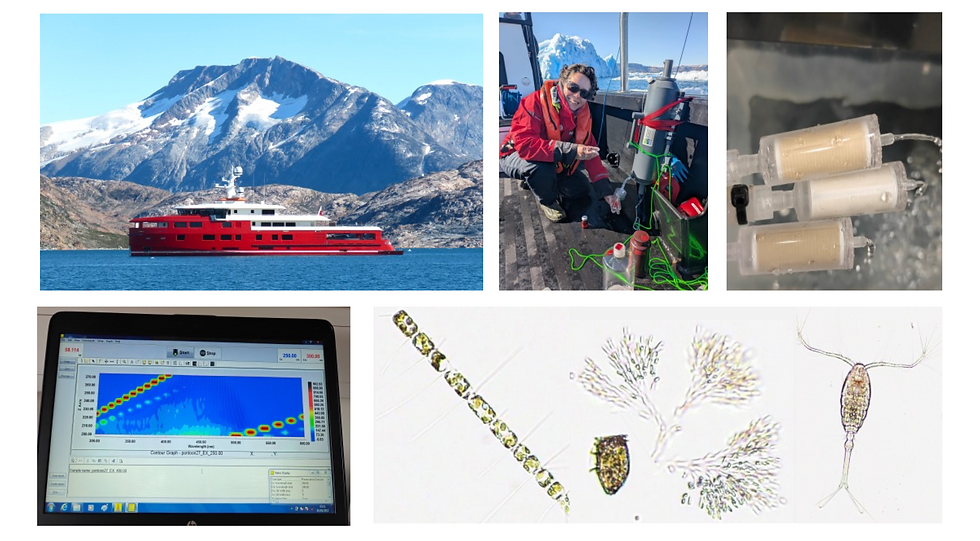
Supported by an Augmentum grant, a research team from the National Oceanography Centre conducted a two-week field campaign across the southeast and southwest coasts of Greenland in summer 2025, sampling three fjords: two influenced by marine-terminating glaciers and one by a land-terminating glacier. Using both well-established and cutting-edge oceanographic methods, including flow-imaging microscopy and environmental DNA sequencing, they examined the different water masses flowing through each fjord, their physical and chemical properties (such as temperature, salinity, dissolved oxygen, and nutrients), the origin and character of dissolved organic matter, and the full diversity of microplankton communities living in those waters. Microplankton, composed of phytoplankton (microscopic algae) and bacteria and archaea, forms the foundation of marine food webs and drives ocean carbon cycling. Now, almost a year later, the project is complete and all the samples have been analysed.
What we found?
Glacier type shapes the origin and character of dissolved organic matter. In fjords fed by MTG, higher concentrations of dissolved organic matter were found in saltier marine waters, pointing to a mainly marine origin. By contrast, in the fjord influenced by a LTG, the highest concentrations appeared near river runoff, carrying the chemical signatures of soils and terrestrial vegetation. This confirms that the source of organic matter in fjord systems is fundamentally linked to glacier type.
Land-terminating glacier fjords can be rich, diverse ecosystems. Previous research suggested that fjords fed by LTG are less productive, home to smaller and fewer organisms. Our data challenged this view. They found remarkable biodiversity in the microplankton community of the LTG fjord sampled. The glacial influence was largely confined to the first 10 kilometres of the fjord, and strong mixing of the water column beyond that zone delivered nutrients, creating ideal conditions for a rich variety of phytoplankton to grow. This finding has important implications for how we project the future of Arctic marine ecosystems.
Marine-terminating glacier fjords host distinct ecological niches at different depths. In fjords fed by MTG, the researchers observed a layered structure of microplankton communities at different depths. Near the surface, communities from freshwater glacial melt gradually mixed with those from saltier coastal waters. But at 15 and 45 metres depth, the communities were clearly distinct, separated by the sharp boundary between water masses. This demonstrates that these fjords are not uniform environments, but contain multiple ecological niches shaped by the physical structure of the water column.
Two archaea with key ecosystem roles detected in deeper fjord waters. Analysis of environmental DNA from the deeper, saltier coastal waters revealed the presence of two archaeal group (single-celled microbes) absent from the surface glacial melt waters. One is known to play a critical role in the nitrogen cycle, making nutrients available for other organisms. The other breaks down organic carbon, releasing nitrogen compounds that feed the wider ecosystem. As glaciers retreat and water column mixing changes, these two organisms may become increasingly important in sustaining the productivity of Arctic fjord systems.

The bigger picture
The transition from marine-terminating to land-terminating glaciers does not affect all fjords in the same way. Local conditions, the geography of the fjord, the degree of water mixing, the physical environment of each fjord, will shape how individual ecosystems respond to glacier retreat. Some systems may prove more resilient than previously assumed. This matters for the people of Greenland and the wider Arctic, whose food security, culture, and livelihoods are closely tied to the health of these marine environments. It also matters for our understanding of how the ocean will regulate carbon and nutrients in a warming world.
What comes next
The team is currently preparing a manuscript for publication in a scientific journal, which will share these findings with the broader research community. The dataset collected will also be used to explore the connectivity between different groups of phytoplankton and bacteria, identifying which organisms act as key ‘hubs’, linking different parts of the community together. Understanding these partnerships is essential for predicting how Arctic marine systems will respond as the climate continues to change.


Comments